Choosing an LGBTQ+ Dating Service
Dating services worth comparing for this decision
These are not a universal ranking. They are services discussed in this guide or closely matched to its audience and relationship intent, using the structured Dating Site Index database.

HER
HER is a dating and social community app designed primarily for queer women, lesbians, bisexual people, nonbinary people, transgender people, and other sapphic users. It…
- Best for
- Dating, Relationship, Community
- Free
- Not clearly confirmed
- Access
- Ios, Android, IOS, Mobile App, Web
- Verification
- No specific verification detail confirmed

Match
Match is an online dating service for adults seeking meaningful connections, including serious relationships and people who are still exploring their dating goals. Members create…
- Best for
- Serious Relationships, Meaningful Connections, Local Dating
- Free
- Yes — core access available free
- Access
- Web, IPhone, Android
- Verification
- Match describes profile checks and safety processes, but registration states that no criminal…
Taimi
Taimi is an LGBTQ+ dating and social app for adults seeking romance, friendship, conversation, or other meaningful connections. It supports people across sexual orientations and…
- Best for
- Dating, Romantic Relationships, Friendship
- Free
- Yes — core access available free
- Access
- Web, IPhone, Android
- Verification
- Optional profile or photo verification can produce a verification badge; Taimi states that…

Grindr
Grindr is a location-based social and dating service for adults in the LGBTQ community, with a strong focus on gay, bisexual, trans and queer users.…
- Best for
- Friendship, Dating, Social Connection
- Free
- Yes — core access available free
- Access
- Web, IPhone, Android
- Verification
- No universal identity-verification requirement was verified from the reviewed sources
BiCupid
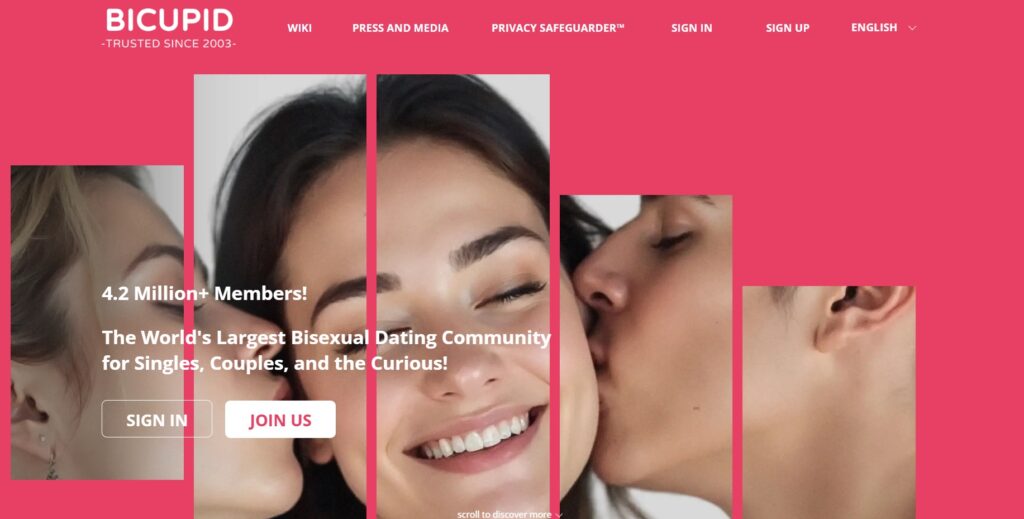
BiCupid is a bisexual-focused online dating service for adults, including bisexual and bi-curious singles, couples, and other open-minded LGBTQ+ users. Members can create profiles, browse…
- Best for
- Bisexual Dating, Bi Curious Dating, LGBTQ+ Dating
- Free
- Yes — core access available free
- Access
- Web
- Verification
- No comprehensive identity or background-check verification is stated; users are advised to use…
Compare the practical differences
Use this as a shortlist, then read the guide below for the trade-offs that matter for this audience.
| Service | Best for | Free option | Platforms | Matching | Verification | |
|---|---|---|---|---|---|---|
| HER | Dating, Relationship, Community | Not clearly confirmed | Ios, Android, IOS, Mobile App, Web | Not clearly documented | No specific verification detail confirmed | Visit ↗ |
| Match | Serious Relationships, Meaningful Connections, Local Dating | Yes — core access available free | Web, IPhone, Android | Profile recommendations, search and preference filters, dating-intention information, and member browsing. | Match describes profile checks and safety processes, but registration states that no criminal background checks are conducted. | Visit ↗ |
| Taimi | Dating, Romantic Relationships, Friendship | Yes — core access available free | Web, IPhone, Android | Discovery recommendations based on profile preferences, location, interests, identity-related information, and in-app behavior; users like or skip profiles… | Optional profile or photo verification can produce a verification badge; Taimi states that submitted verification photos are handled… | Visit ↗ |
| Grindr | Friendship, Dating, Social Connection | Yes — core access available free | Web, IPhone, Android | Location-based browsing through a nearby grid, with tags, filters, Explore and recommendation features | No universal identity-verification requirement was verified from the reviewed sources | Visit ↗ |
| BiCupid | Bisexual Dating, Bi Curious Dating, LGBTQ+ Dating | Yes — core access available free | Web | Profile browsing and search using location, preferences, advanced filters, member discovery tools, and stated relationship goals. | No comprehensive identity or background-check verification is stated; users are advised to use caution and report suspicious activity. | Visit ↗ |
Use the Dating Site Index finder
Filter by age, relationship goal, interests, country and platform instead of choosing from a generic popularity list.
We may earn a commission if you join a service through an outbound link. Service selection and the guide's editorial content are kept separate from affiliate payout.
Choosing an LGBTQ+ dating service is easier when you start with your goals rather than with a particular brand. Some services are built around nearby profile browsing, while others emphasize detailed compatibility questions, community conversations, events, or broad identity options. Privacy tools, verification, moderation, geography, and relationship expectations can also vary significantly.
Quick decision framework: first identify the people and identities you want to meet; then decide whether you prefer algorithmic matching, search and browsing, or community-based discovery. Next, check privacy and safety controls, confirm that the service is active where you live, and review whether its relationship culture matches what you want.
1. Start with audience focus and identity options
LGBTQ+ dating services are not all designed for the same audience. A broad LGBTQ+ app may include gay, lesbian, bisexual, transgender, nonbinary, queer, asexual, pansexual, and polyamorous users. A more focused service may be better if you want to meet people who share a particular identity, orientation, or dating experience.
- Broad LGBTQ+ communities: Taimi and Grindr are designed for LGBTQ+ users across multiple identities, although their discovery styles and typical audiences differ.
- Queer women and sapphic dating: HER focuses primarily on queer women, lesbians, bisexual people, nonbinary people, transgender people, and other sapphic users. Its community and event features may matter as much as profile matching.
- Bisexual and bi-curious dating: BiCupid is specifically oriented toward bisexual and bi-curious adults, including singles and couples.
- Inclusive general dating: OkCupid offers identity and orientation options within a broader dating service and may suit people who want LGBTQ+ inclusion alongside detailed compatibility tools.
- Open-minded or nontraditional relationships: Feeld supports individual and linked partner profiles and is designed for people exploring relationship preferences, couples connections, and consensual non-monogamy.
Availability of a label does not necessarily mean that every member uses it in the same way. Before joining, check how profiles display gender, pronouns, sexual orientation, relationship structure, and dating preferences. If a service gives you control over which details are visible, that can be important when you are not ready to disclose everything publicly.
For more focused browsing, see LGBTQ+ Dating, Gay Dating, Lesbian Dating, and Bisexual Dating.
2. Choose the matching style that fits you
Profile browsing and nearby discovery
Grindr is centered on a nearby profile grid, making location-based discovery its defining feature. This can be useful if you want to see who is active around you, meet people while traveling, or begin with direct conversation. Taimi also uses discovery recommendations, likes, skips, and mutual matches, while HER combines profile discovery with social and community features.
Location-based services can be efficient, but they may feel less suitable if you prefer a slower or more private introduction. Location permissions and distance information also deserve careful review before you begin messaging.
Question-based compatibility
OkCupid emphasizes profile information, interests, preferences, dealbreakers, and answers to matching questions. Its compatibility percentages are intended to help users compare values and preferences rather than relying only on photographs. This approach may suit people who want more written context before deciding whether to start a conversation.
Compatibility scores should be treated as a guide, not a prediction. They reflect the information entered by users and the service’s matching system, and they cannot confirm someone’s honesty, intentions, or behavior.
Community-led discovery
HER adds interest communities, events, and LGBTQIA+ conversation spaces. BiCupid includes topic groups, events, albums, videos, and other community features. These formats can help people meet through shared interests or local activities instead of treating dating as a sequence of profile decisions.
Community features may be especially useful if you want friendship, social connection, or a way to learn about local LGBTQ+ activity before pursuing a relationship.
3. Match the service to your relationship intent
Be clear about whether you want a serious relationship, casual dating, friendship, community, travel connections, or open-ended conversation. Services often support several goals, but their design can encourage different styles of interaction.
- Serious or compatibility-focused dating: OkCupid may be worth considering if you want detailed profiles, values, questions, and relationship preferences.
- Dating plus friendship and community: HER and Taimi include social features alongside dating discovery.
- Local conversation and casual connections: Grindr is strongly oriented toward nearby discovery, chat, friendship, dating, and travel-related connections.
- Bisexual, bi-curious, or couples dating: BiCupid specifically includes bisexual adults, bi-curious users, couples, and open-minded relationship goals.
- Open-minded relationship exploration: Feeld is designed for people exploring relationship structures, linked profiles, and consensual non-monogamy.
Some services support a wide range of intentions without guaranteeing a particular outcome. Read profiles carefully, state your own expectations early, and ask questions before assuming that another person wants the same type of relationship.
If you are exploring open relationships or nontraditional dating, you can also review Open-Minded Dating and Poly & ENM Dating.
4. Review privacy and visibility controls
Privacy matters for many LGBTQ+ daters, including people who are questioning, not publicly out, living in a small community, or concerned about workplace, family, or safety implications. Look for controls that let you limit profile visibility, hide or blur photos, control location details, block accounts, and report unwanted behavior.
Examples in the services reviewed include Stealth Mode on Taimi, Incognito Mode on Feeld and OkCupid, private photos on Feeld and Grindr, profile visibility controls on several services, and location-fuzzing or anonymous browsing features on some products. These features are confirmed only where documented in the available service information; they may differ by account type, device, region, or current product version.
Before uploading sensitive photos or identifying information, check whether images can be downloaded, screenshotted, or shared by other users. Privacy settings reduce exposure but cannot prevent every form of misuse. Use a display name when appropriate, avoid posting your home or workplace details, and keep early conversations on the service until trust has developed.
5. Consider moderation and verification carefully
Moderation and verification are related but different. Moderation may involve reviewing reports, removing prohibited content, or detecting suspicious behavior. Verification may confirm a particular photo, identity document, or account signal. Neither guarantees that every profile is genuine or safe.
- Feeld: offers optional photo verification, reporting tools, community guidelines, and a safety team.
- Taimi: offers optional profile or photo verification, blocking, reporting, live support, and suspicious-account reporting.
- Flure: describes identity verification using government identification and biometric checks for verified users, along with moderation and anti-scam measures.
- Grindr and OkCupid: provide blocking and reporting tools, but the available information does not confirm universal identity verification.
- BiCupid: provides privacy and reporting-related tools, but no comprehensive identity or background-check verification is stated.
These are documented features, not guarantees of safety. A verified badge may confirm only the step used by that service. Continue to watch for requests for money, pressure to move quickly, inconsistent stories, and attempts to move conversations away from the platform immediately.
6. Check geography and local activity
A service may be available internationally while still having limited activity in your town or region. Grindr, HER, Taimi, Feeld, OkCupid, and BiCupid are described as serving international audiences, but the number of relevant profiles, events, languages, and available features can vary by location.
For local dating, prioritize services with enough active members nearby and discovery tools that let you control distance or location. For travel or long-distance connections, look for country-based search, Explore features, international discovery, or the ability to browse another location without exposing more personal information than you intend.
Before paying, search your area and check whether recent activity appears relevant to you. App availability, age-verification requirements, payment options, and features may also change according to local laws and platform policies.
7. Understand free and paid access
Most services in this guide offer a free tier, but the limits differ. Free access may include profile creation, browsing, likes, basic chat, or community participation. Paid plans may add unlimited likes, advanced filters, incognito browsing, expanded messaging, visibility tools, or additional discovery controls.
Grindr, Feeld, HER, OkCupid, Taimi, and BiCupid all describe optional paid features or memberships. Exact prices are not consistent across regions and may vary by platform, subscription length, taxes, or product version. Some services also use automatically renewing subscriptions, so review the billing screen and cancellation terms before confirming payment.
A free account is often the best way to test local activity, profile quality, identity options, and conversation culture. Upgrade only when a paid feature solves a specific problem for you, such as needing more filters or stronger visibility controls.
Final checklist
- Does the service actively include the identities and relationship styles you want?
- Can you describe your gender, pronouns, orientation, and relationship preferences accurately?
- Do you prefer nearby browsing, algorithmic recommendations, questions, or community events?
- Are blocking, reporting, visibility, photo, and location controls easy to find?
- Is the service active in your area or useful for the locations you care about?
- Does its relationship culture match your intentions?
- Can you test the free experience before committing to a subscription?
- Have you reviewed renewal, cancellation, privacy, and data-deletion information?
There is no universal best LGBTQ+ dating service. The right choice is the one that gives you suitable identity options, a realistic pool of people in your area, a matching style you enjoy, and enough control to communicate at your own pace. To compare more options, visit Dating services or use Find your dating site.